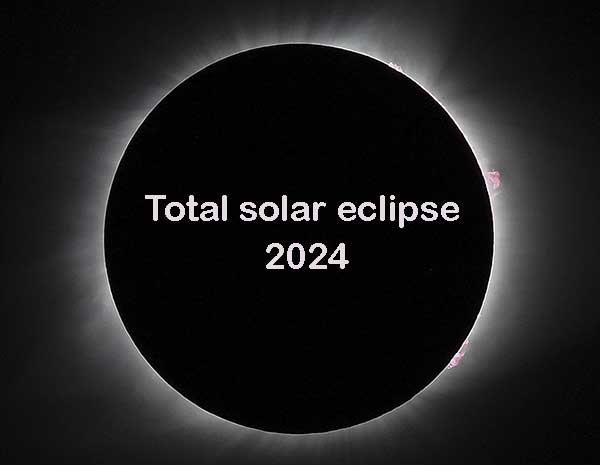
The full solar eclipse happening on April 8, 2024, on Monday. It overlaps with the end of Ramadan, which has people talking about how it might affect the sighting of the moon for Eid al-Fitr. It will be observable from Western Europe, North America, South America, the Pacific, the Atlantic, and the Arctic. Even though the eclipse gives us a special chance to see the new moon directly. However, experts aren’t sure if we’ll be able to see the crescent moon right after the eclipse. Local religious leaders might give advice based on both scientific facts and old customs.
What is a solar eclipse?
A solar eclipse happens when the Moon moves between the Sun and the Earth, blocking out the Sun’s light. It’s like the Moon is casting a shadow on the Earth. During a solar eclipse, it gets dark during the day for a short time, and you can sometimes see the Sun looking like a ring or a crescent. Solar eclipses are exciting events that happen every now and then, and people all over the world love to watch them!
Total Solar Eclipse
During a total eclipse, the Moon appears nearly the same size as the Sun and covers the entire solar disk for a brief period, which is called totality.`
When and Where can we see the Eclipse?
This year’s eclipse will travel over more populated parts of the continental U.S. than previous total solar eclipses. NASA says about 31.6 million people live where they can see the total eclipse. Another 150 million people live within 200 miles of this path, according to NASA.
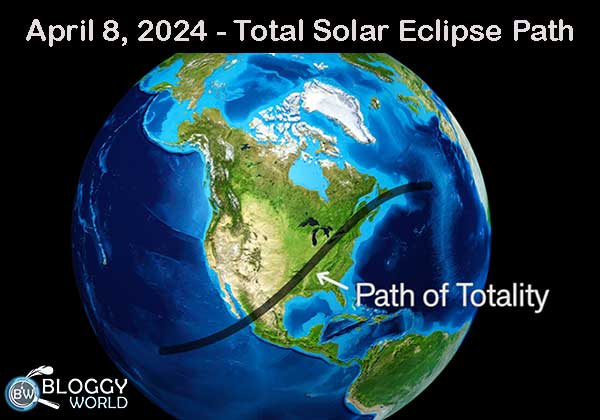
Path of the solar eclipse 2024
The path of totality, which is 115 miles wide, will go through three states in Mexico, fifteen states in the United States, and four states in southeastern Canada.
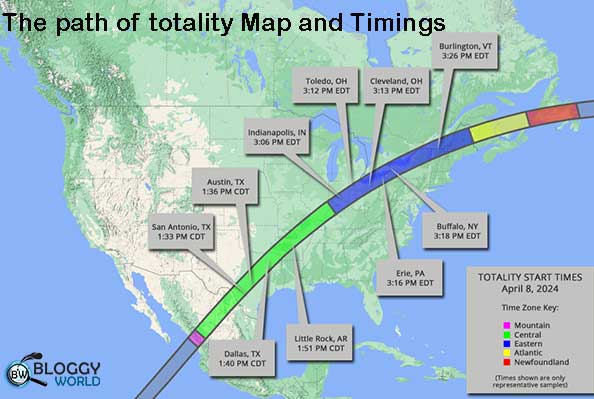
Where to see the April 8, 2024 total solar eclipse?
Here are the timings for various cities along the path where the eclipse will be total, as shared by NASA. You can also check other websites like NationalEclipse.com and TimeandDate.com for more help with planning.
| Location | Totality begins (local time) | Totality duration |
|---|---|---|
| Mazatlán, Sinaloa, Mexico | 11:07 a.m. MST | 4 minutes 20 seconds |
| Durango, Durango, Mexico | 12:12 p.m. CST | 3 minutes 50 seconds |
| Torreón, Coahuila, Mexico | 12:16 p.m. CST | 4 minutes 11 seconds |
| Piedras Negras, Coahuila, Mexico/Eagle Pass, Texas, U.S | 1:27 p.m. CDT | 4 minutes 24 seconds |
| Kerrville, Texas, U.S | 1:32 p.m. CDT | 4 minutes 25 seconds |
| Fredericksburg, Texas, U.S | 1:32 p.m. CDT | 4 minutes 25 seconds |
| Dallas, Texas, U.S | 1:40 p.m. CDT | 3 minutes 52 seconds |
| Idabel, Oklahoma, U.S | 1:45 p.m. CDT | 4 minutes 19 seconds |
| Russellville, Arkansas, U.S | 1:49 p.m. CDT | 4 minutes 12 seconds |
| Cape Girardeau, Missouri, U.S | 1:58 p.m. CDT | 4 minutes 7 seconds |
| Carbondale, Illinois, U.S | 1:59 p.m. CDT | 4 minutes 10 seconds |
| Bloomington, Indiana, U.S | 3:04 p.m. EDT | 4 minutes 3 seconds |
| Indianapolis, Indiana, U.S | 3:06 p.m. EDT | 3 minutes 51 seconds |
| Cleveland, Ohio, U.S | 3:13 p.m. EDT | 3 minutes 50 seconds |
| Erie, Pennsylvania, U.S | 3:16 p.m. EDT | 3 minutes 43 seconds |
| Rochester, New York, U.S | 3:20 p.m. EDT | 3 minutes 40 seconds |
| Montpelier, Vermont, U.S | 3:27 p.m. EDT | 1 minute 42 seconds |
| Oakfield, Maine, U.S | 3:31 p.m. EDT | 3 minutes 23 seconds |
| Niagara Falls, Ontario, Canada | 3:18 p.m. EDT | 3 minutes 31 seconds |
| Montreal, Quebec, Canada | 3:26 p.m. EDT | 1 minute 57 seconds |
| Miramichi, New Brunswick, Canada | 4:34 p.m. ADT | 3 minutes 8 seconds |
| Tignish, Prince Edward Island, Canada | 4:35 p.m. ADT | 3 minutes 12 seconds |
| Catalina, Newfoundland, Canada | 5:13 p.m. NDT | 2 minutes 53 seconds |
Locations Along The Path Of Partial Eclipse
| City | Partial Eclipse Begins | Totality Begins |
|---|---|---|
| Dallas | 12:23 p.m. CT | 1:40 p.m. |
| Little Rock, Arkansas | 12:33 p.m. CT | 1:51 p.m. |
| Cleveland | 1:59 p.m. ET | 3:13 p.m. |
| Buffalo, New York | 2:04 p.m. ET | 3:18 p.m. |
| Lancaster, NH | 2:16 p.m. ET | 3:27 p.m. |
Precautions During a Solar Eclipse:
You should never look directly at the sun, even if it’s partly covered by the moon. You need special glasses made for watching eclipses or a pinhole projector to protect your eyes. If you don’t use these precautions, you could seriously hurt your eyes, According to NASA. here are the Precautions During a Solar Eclipse:
- Never look directly at the sun without proper eye protection.
- Use solar viewing devices, like telescopes or binoculars.
- Protect cameras and smartphones with solar filters when taking photos of the eclipse.
- Avoid using homemade or improvised viewing devices, as they may not provide adequate protection.
- Keep pets indoors to prevent them from staring at the sun during the eclipse.
- Stay informed about the timing and duration of the eclipse to avoid accidentally looking at the sun.
- Do not attempt to watch the eclipse while driving.
- Use caution when participating in eclipse-related activities to prevent accidents or injuries.
- Educate children about the dangers of looking directly at the sun and provide them with proper eye protection.
- If you experience any discomfort or vision problems after viewing the eclipse, seek medical attention immediately.
Best High-Quality Solar Eclipse Glasses
The upcoming total solar eclipse is just a few days away on April 8th, and it’s crucial to never look directly at the sun without proper protection. To keep you and your family safe while viewing the eclipse, make sure to get a pair of certified solar eclipse glasses from trusted sellers we recommend below.
Best Solar Eclipse Glasses at Amazon
- Soluna Two-Pack Solar Eclipse Glasses 2024, $17 (was $20)
- Lunt Five-Pack Premium Solar Eclipse Glasses 2024, $20.
- Kesseph 10-Pack Solar Eclipse Glasses 2024, $20.
- Helioclipse 12-Pack Solar Eclipse Glasses 2024, $20 (was $25)
- Medical King 10-Pack Solar Eclipse Glasses 2024, $16.
Best Solar Eclipse Glasses Deals at other stores
- Target: Discounted ISO-certified solar glasses
- Walmart: Solar glasses, binoculars and filters available
- Staples: Solar eclipse multipack available
- Best Buy: Solar glasses, viewers, telescopes and binoculars
- B&H Photo Video: Single and multipack eclipse glasses
- Adorama: Solar eclipse glasses and filter adapter kits
When is the next solar eclipse?
The next total solar eclipse will happen in 2026, but it’ll mostly be seen over the Arctic Ocean. Some people in Greenland, Iceland, Portugal, and northern Spain might also be able to see it. Then, in 2027, a total solar eclipse will be visible in Spain and parts of northern Africa.
Solar Eclipse, Ramadan, and Eid al-Fitr:
So, in most Islamic countries, it’s expected that the crescent moon will be seen after the sun sets on April 9. So, according to Harper’s Bazaar Arabia, April 10 is probably the first day of Shawwal and Eid al-Fitr.
The eclipse happening on Monday will be in the afternoon. Eclipse expert Michael Zeiler explained to USA TODAY that the moon will be very young, only about 5 to 6 hours old, by sunset. This means it won’t be possible to see the crescent moon that evening. According to the United States Naval Observatory, spotting a lunar crescent within a day of a new moon, which happens during a solar eclipse, is usually tricky.