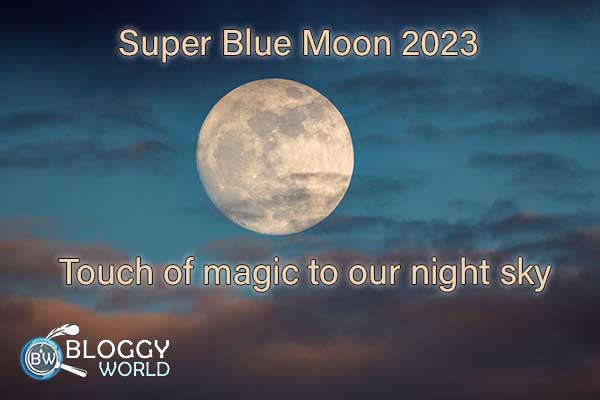
Blue Moon 2023, a rare event, a second Full Moon within a single month appears in the sky. If you’ve ever wondered about this intriguing occurrence, you’re in for a treat. Let’s dive into the world of Super Blue Moon, uncovering their rarity, the truth about their color, and a special date in August 2023.
What is a Blue Moon?
A Blue Moon isn’t actually blue, despite its name. It refers to an event when we witness an extra Full Moon within a single calendar month. Usually, there’s one Full Moon per month, but occasionally, the timing aligns so that we get two. This second Full Moon is known as a Blue Moon. It’s like a surprise guest in the lunar calendar.
Types :
- Monthly Blue Moon: When two Full Moons occur within the same calendar month.
- Seasonal Blue Moon: The third Full Moon in an astronomical season that has four Full Moons, according to NASA.
When Is the Next Blue Moon?
Blue Moon will occur on Aug. 30, 2023, at 9:35 p.m. ET (0135 GMT on August 31.) August’s “Super Blue Moon” will be the biggest and brightest full moon of the year.
The next seasonal Blue Moon takes place on August 19/20, 2024.
How Rare is a Blue Moon?
Yes! But this is an extremely rare event, you could even say it happens “once in a Blue Moon“.
Back in 1883, there was a big volcanic eruption from a volcano in Indonesia called Krakatoa. This caused a lot of tiny ash pieces to go up really high into the sky. These little ash pieces were so small, like a speck of dust, and they made the moon look like it was blue-green. NASA says that similar things happened with other volcanic eruptions. In 1983, a volcano in Mexico called El Chichon erupted and caused a super blue moon. There were also eruptions from Mount St. Helens in 1980 and Mount Pinatubo in 1991 that made the moon look blue too.
Can a Blue Moon Actually Turn Blue?
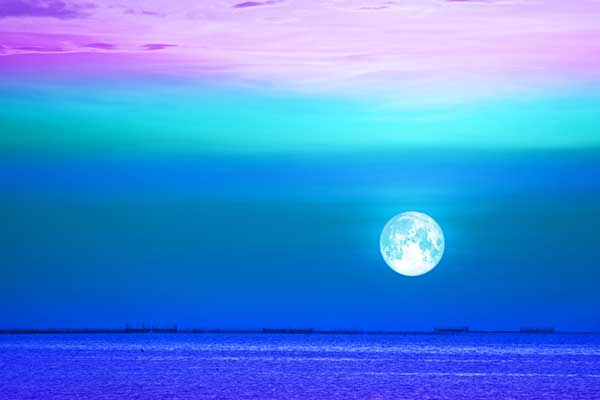
Despite the name, a Blue Moon doesn’t actually turn blue in color. The term “Blue Moon” has nothing to do with the moon’s hue. It’s all about timing. The moon can appear blue in color only in very specific atmospheric conditions, like when there’s a lot of dust or smoke particles in the air. However, this is extremely rare and unrelated to the Blue Moon event we’re discussing.
How Often Does it Happen?
As mentioned earlier, Blue Moons happen approximately every two to three years. This interval gives us a chance to witness a unique celestial event that breaks the usual monthly rhythm of Full Moons. It’s a special treat for those who love observing the night sky.
Blue Moon August 2023: Mark Your Calendars!
On the night of August 30th and 31st, 2023, a Blue Moon will grace the sky. This Full Moon is the second one to occur in August, making it a monthly Blue Moon. While it won’t be blue in color, it will shine brightly, lighting up the night and capturing our attention.
Supermoon vs. Blue Moon:
Supermoon:
- Definition: A supermoon is a Full Moon that appears larger and brighter in the sky than a regular Full Moon.
- Cause: It occurs when the Moon is at its closest point to Earth in its elliptical orbit (perigee).
- Size and Brightness: A supermoon can appear around 14% larger and 30% brighter than a Full Moon at its farthest point from Earth (apogee).
- Frequency: Supermoons happen a few times each year, as the Moon’s orbit brings it closer to Earth periodically.
- Visual Impact: A Supermoon appears closer to the horizon and can create visually striking moments, often inspiring awe and wonder among observers.
Blue Moon:
- Definition: A Blue Moon refers to the second Full Moon that occurs within a single calendar month.
- Cause: The term is based on the lunar calendar’s timing rather than the Moon’s appearance.
- Color: Despite the name, it is not actually blue in color. The name relates to its rarity rather than its hue.
- Frequency: These are relatively rare, occurring about once every two to three years, when the timing of Full Moons aligns with this phenomenon.
- Significance: The phrase “Once in a Blue Moon” signifies a rare event, and these occurrences have captured cultural imagination.
- Observational Aspect: Blue Moons might not look distinguishable from regular Full Moons, but their occurrence adds a touch of excitement to the lunar calendar.
So, if you’re a fan of celestial wonders and rare occurrences, don’t miss the chance to witness the August 2023 Blue Moon. Remember, it’s a special event that adds a touch of magic to our night sky, reminding us of the beauty and mysteries that await beyond our world.