

Next space mission after landing on the moon:
India is gearing up for an exciting space-based solar mission. ISRO Launch Aditya-L1 mission First space-based India’s mission to study the Sun. This mission is set for sun exploration and its outer corona. After the successful Chandrayaan-3 landing on the moon, this is the next upcoming launch. The mission is scheduled to be launched in early September 2023. In this article, we will provide details about what is Aditya L-1 project? when will Aditya L-1 launch? what is Aditya L-1 mission?
What is Aditya-L1?
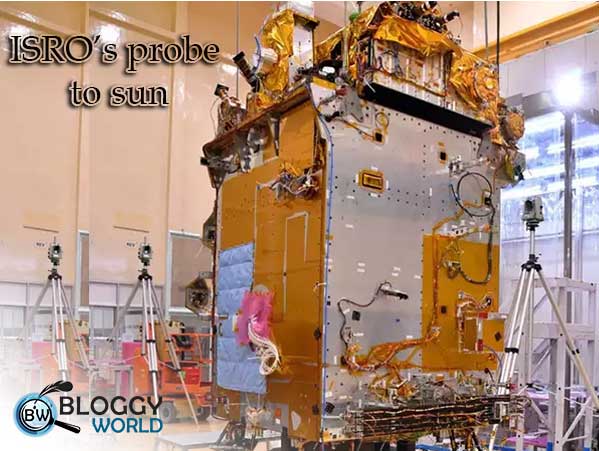
Aditya-L1 is a satellite that weighs about 1500 kilograms. It has seven special tools on board, called payloads. These payloads help us look at different parts of the Sun, the photosphere, chromosphere, and corona in different wavebands. The major science objective of the ISRO Launch Aditya-L1 mission is to study the solar upper atmosphere.
What will Aditya-L1 do?
Aditya L1’s payloads have the capability to capture diverse forms of light. Such as ultraviolet and X-rays, allowing scientists to study the Sun’s behavior in detail. Additionally, the tools can analyze particles emitted by the Sun and its magnetic field, providing a deeper understanding of solar activities and their impacts.
When Aditya-L1 will launch?
ISRO Launch Aditya-L1 Mission After Chandrayaan-3 to study the Sun.” Most likely the launch will take place on September 2 “, an ISRO official said as quoted by the news agency PTI.
Mission and objectives:
In 2006, some scientists from the Indian Institute of Astrophysics and the Astronomical Society of India had an idea. They shared a plan with ISRO to keep an eye on the Sun using a small satellite. As time went on, this plan grew bigger. The mission turned into a special observatory to study both the Sun and the space around it. They will place this observatory in a special spot called the Lagrange point L1.
Position around the orbit:
Aditya L1 will go into a special circular path around a place called Lagrange point L1. This point is about 1.5 million kilometers away from Earth. By being in this spot, the satellite can always watch the Sun without any breaks. This helps scientists learn about the Sun’s actions and how they affect space weather right away. Putting a spacecraft exactly at L1 needs careful moving and controlling because of how gravity works.

Leadership and Collaboration:
Sankarasubramanian K is leading the Aditya L1 mission. He became the Principal Scientist for this project in October 2022. The spacecraft was built at the U R Rao Satellite Centre in Bengaluru and has reached SDSC-SHAR in Sriharikota. The Indian Institute of Astrophysics (IIA) and the Inter-University Centre for Astronomy and Astrophysics in Pune are also part of this mission. IIA is working on the ‘Visible Emission Line Coronagraph payload,’ and the Pune-based institution is creating the Solar Ultraviolet Imager payload for the mission.
ISRO lauch Aditya L1 mission cost?
The Aditya L1 mission’s cost in Indian rupees is 825,48,25,000, approximately equivalent to one hundred million dollars. Space exploration (sun exploration) is a costly venture, after the launch of Aditya-L1 the expenses can reach millions or even billions of dollars. Despite this, the space mission holds potential benefits for our nation and space discoveries. This highlights the importance of space agencies being efficient in planning and executing missions. The launch of Aditya L1 provides India with a cost-effective means to study the sun and gain valuable insights. The estimated total mission cost is a fraction of what similar missions by other countries may incur.
A Leap into Solar Science:
In the world of space science, the Aditya L1 mission ( sun exploration) shows how much India has moved forward. As the launch date gets closer, people are really excited to see all the valuable information and things we’ll learn from ISRO’s Aditya L1.


